Showing posts with label retail. Show all posts

21 October 2014

Good as new!

0 Comment
Interesting that Sneakerology is still constantly requested by press after the years!

It is published this time by Index Book from Barcelona, Spain as one of the "...projects that represent the forefront of retail design".

I sometimes wonder what defines Architecture.
At this moment, for me, it is about "timelessness".

Maybe Sneakerology is on its way to becoming Architecture...


19 February 2014

Eki finalised

0 Comment
A few of the finalised photos of Eki.


Eki is the official distributor for high end hair products, mainly Shiseido Professional.
The limited space has to multi-task between showroom, office space, product dispatch centre - basically the "pretty side" and the "paddling side" of a business.

We have created a pure space for the products, which also multi-tasks; display shelves can be placed anywhere within the white cube with the system we custom designed for the project, 2 projection screens can be used for different purposes simultaneously or independently... and as everything can be tucked away, the space itself can be used to house functions such as product launch and award presentation.

The "pretty side" of business is what "sells"; but it does not exist independent of the "paddling side" which holds everything together.  In Eki the "paddling side" of business surrounds the "pretty side", holding it together literally.

... more photos to come ...

14 October 2013

Different trade

0 Comment
For the project Eki, we have been challenging prefabrication and customised fabrication...

Although we have been working a lot with timber prefabrication, the new field for us this time is steel manufacturing.
Major difference between steel and timber prefabrication is the flexibility to modify on site - with timber, it is a fairly flexible and workable material; with steel everything pretty much need to be spot on and there is very little can be done on site.  Hence the importance of prototyping.

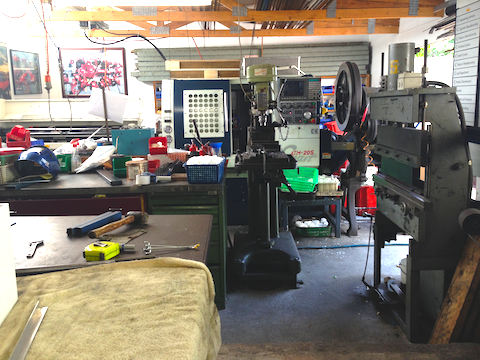
For a small (but of vital importance) fixture we are designing for Eki's display system, I took a road trip (can I exaggerate any more?) to Sydney's South West and visited the metal workshop.

It is important for us architects to gain a good understanding of how different trades work... where did I hear this from?

"In order to design well, one needs to feel the weight a tradesperson carries"

fantastic blue sky.
Thanks to Joe from Impact Metalworks for picking me up from the station!

intimate workshop


bending ...

pressing ...

hammering ...

12 August 2013

Calculated accidents

0 Comment
I thought it is about time to share some "behind the scene" of Blu Creativity.

 
It is a kind of project which comes across as "effortless", because that is what we try to achieve, a relaxed sense of resort escape - of course everything needs to look effortless!
....but is it really.... nah....never....

With Blu Creativity our aim is to create a "resort escape in the middle of the city", and we are approaching it in 2 ways:
1. by visualising natural phenomenon - wind;
2. by blurring the sense of boundary with layers of porous and translucent space divisions.

.... and whatever seems accidental.... was not.......

large model to study the spatial quality in detail...even the "jungle gym" and curtains were built 

testing relationship between overhead fan and curtain height: (from left to right) same height / curtain higher than fan / curtain lower than fan... truth be told, the way air moves is very different from what we expected... 
installing the fan
very organised and methodological welding process.... as welding was taking place on site to encase the existing heritage structure without touching it, a lot of care and precision was required
slowly....one by one..... lots of patience
setting out of joinery units by electrician and joiner...
all electrical work was concealed in joinery units so they had to work very closely
as with all old buildings, what looks square is never square., what looks straight is never straight
... it took a long time to determine what is "centre" in this context..
a sea of joinery....
huge waiting table was brought in in 2 pieces and joint on site.
all joinery were also designed with "holes" in them, so to not disturb the air movement

5 August 2013

Yet another year - IDEA 2013 is approaching

0 Comment
Seems like yesterday that me and Yoshi flew over to Melbourne for IDEA Awards 2012 Jury days, suddenly we are already presenting for IDEA Awards 2013.
This year the Jury presentation took place in Sydney, and the award ceremony will take place in Melbourne later this year.

I presented Blu Creativity, shortlisted under Retail category.

Blu Creativity - a resort escape in the middle of the city

at the presentation venue... this is Room 1 where I presented, with more public viewing

This is Room 2, where other categories are presenting at the same time.  I am not sure which room I would prefer ... to have more people looking or to be up close with the jury panel...

13 March 2013

A bit more on other projects....

0 Comment
Rounding up some recent publications....

Hospitality:

Powerful imagery of Uchi Lounge has a strong presence in WORKshop issue 08.
Nice to read in the blog of our structural engineer for Uchi Lounge: "...It is interesting how tight budgets and great architects drive great engineering."
I guess true creativity spark when being confined by restrictions...


 Cover of WORKshop issue 08

Watermoon is published by Chinese publishing house Sandu (available via PageOne) in "Taste It! - Innovative Restaurant Interiors".
It is also published by German publishing house Gestalten in "Let's Go Out! - Interiors and Architecture for Restaurants and Bars".
Watermoon was completed in 2010 May.
In the retail / hospitality world, where fitouts require constant renewal, Watermoon is considered an "old project".  Yet it continues to be picked up by publishing houses and gathering attention.  I think this says something about our consistent attitude towards architecture (permanence) and interior (transience).


Cover of "Taste it!"


Cover of "Let's Go Out!"

Retail:

Sneakerology and Streetology continue to gather attention after their completion in 2010 / 2011.  The design took place in 2009.
Again, they should be considered "old projects"....but still looking refreshing and stunning (hopefully I am allowed to say that myself...).

We consider longevity of design = ultimate sustainability 

"Brand Spaces - Branded Architecture and the Future of Retail Design" published by Gestalten (Germany)


Retail Design International Vol 74 No 5 (US)


21 March 2012

Sneakerology on InDesign Live

0 Comment
Sneakerology and the news of its Frame Moooi Award shortlisting is announced on InDesign Live.

indesignlive.com

Amongst the 10 shortlisted projects, we are the only one from Australia..

27 February 2012

Turning page

0 Comment
Our project Streetology has been included in German magazine, Page, as a leading examples amongst other international projects to show how the celebration of a vending machine culture and a new creativity has taken the idea further into new sales concepts for stores, marketing and communication all over the world (projects from Amsterdam, Okinawa, Frankfurt, US to Sydney.)


Here is a translation of the article for the curious, courtesy of my lovely German friend Nataly:
"Analog Info Graphic"
The shop design for Streetology in Sydney makes reference to the vending machine concept.  Olivia Shih and Yoshihito Kashiwagi who are running the Architecture Office Facet Studio in Sydney have come up with a concept where T Shirts are displayed in transparent tubes. They are sorted by colours and stacked in 2,550 vending tubes. When a customer buys a T Shirt in green all green T Shirts drop down a spot, effectively creating an analog info graphic display; the bar with the most purchased colour is decreasing the fastest.
The shop design, in cooperation with Simpson Design Associates and Agency babekuehl is celebrating a democratic attitude/ Zeitgeist expressing what is popular on the street - as the name says "Streetology".

11 January 2012

Delaying "speed of consumption"

0 Comment
Kicking start 2012 with an interview by Architype.

Architype Interviews

It is a time-consuming exercise to work on interviews, however it does provide invaluable opportunity for us to reflect and refine our thinkings.

Below I have included the text of the interview for the curious...

--------------------------------------------------------------

What was the most difficult issue about working within this building type or the most unexpected challenge that may have influenced new thought in your project?
We found to design a space which delays the “speed of consumption” in design style something challenging in retail design.
There is certain transience, fashion, and catchiness required of retail design. The investment in producing a retail design reaches its peak in attracting customers at the time of completion; slowly the attraction fades until a new design is required. The lifespan of this design may have been 2-3 years in the past, however it is now reduced to 6 months – 1 year, or less, before consumers start to require new excitement.  This change of speed is most likely brought about by the surplus of information, the accessibility of design news and change of lifestyle in general.
For example, comparing the impressions given by a shop now and 6 months ago, somehow the shop seems to be out of fashion in the 6 months period, although it is exactly the same shop; this is simply because the person looking at the shop feels that it is “out of fashion”.  The design of the shop is dependent upon the material and thematic trend as well as its connotation, hence when this connotation of trend changes according to time, it is without a doubt that the meaning implied by the design changes to cause a different impression.
Therefore we have decided to approach the design of Sneakerology, independent of this “connotation of the material and thematic trend”.  By analyzing the naming of the shop, we discovered its underlying retail philosophy: “to express the merchandise (Sneaker) in a scholarly fashion (-ology)”. We placed our design emphasis on this philosophy, and tirelessly explored methods to give physicality to this philosophy. As a result, we reached a simple expression of “sneaker showcase”; it is in this kind of expression of design essence where we feel a longevity in design style, which will not lose its impressiveness within a mere few years.
Did this project expand or evolve your role as an architect in any way In general, do you feel that the role of the architect is changing on current projects?
Our projects come from not only in Australia but also from many different countries such as Japan, China, and France.  Because of this global nature of our work, seems as though there is a variety of roles we are required to play as architects; however if we think further in depth, fundamentally “what we are doing” is not different from “what we have been doing”.  As long as we are designing space for people, we believe our role is primarily the same.
How is your building possible today in a way that it may not have been before and how have trends in technology and society inspired new thought and solutions?
The genre and amount of available consumables are increasing at an immeasurable rate; it is a curious concern in the modern day that due to this immeasurable increase, it becomes ever so difficult for people to find what they really want.  It is also more likely to find on the Internet cheaper price at any on time one wishes to shop.  Although there are so many benefits brought upon by Internet shopping, we believe the biggest benefit amongst all is the convenience Internet shopping brings to the consumers in simplifying the process to “find what they really want”.
If this is the case, there is no reason why we should not be utilizing the Internet as interface of consumerism.  The consumer who finds what he/ she wants on the Internet, visits the shop after checking merchandise size and availability on the Internet.  He/ she then learns more about the merchandise in detail (such as design concept of the particular sneaker) through the touchpanels located centrally in the shop.  It is important at this point to maintain a consistent numbering system managing the merchandises on the Internet, the touchpanels as well as the “sneaker showcases”.  As soon as the consumer recognizes the merchandise as a sum of data, all he/ she needs to do is to search according to the number assigned to each “sneaker showcase” to be able to see the actual merchandise, and to physically be in contact with the merchandise.  The journey of “find what they really want” in the virtual world is now concluded smoothly in the discovery of the actual merchandise in the shop.
In terms of retail design, we consider the potential of technology lies in its capability to help simplifying the discovery process of “find what they really want”.
In the context of this project, how is your office and design process being influenced by current trends in academic curricula and incoming young architects?  In turn, how are current projects and processes guiding the ongoing reformulation and development of academic curricula?
The recent trend of BIM assisted design gives architects the sense of possibility in new design expressions, and to surprise spectators of the these forms created by utilizing this technology.  However we would like to pause for some thoughts here: “Is it possible that we are simply amazed by our familiarity of this technology, and the complicated unique forms generated by it?”  The foundation of our thinking should remain in defining of design meaning, and the user of the space – human.  A space absent of these 2 elements can be referred to as a “selfish” space created solely by the ego of its architect.
What we have designed for this project is a simple 200mmX600mm “sneaker showcase”.  If we put it in a simplistic manner, all we did was to repeat the “sneaker showcase” 281 times over.  This modularized box was efficiently produced in the factory off-site and to reduce the material wastage as much as we could.  On-site the assemblage is a continuity of simple repetition, with the construction process itself also being of simple nature.  By doing so, the modularized box has a high level of built-in flexibility, which can easily adapt to the unique shape of the site.  Although this space is a product of series of simple processes, the impact it gives people is nothing short of impressiveness.
We believe, this process of giving physicality to a simple idea is still valid in creating spaces that are capable to amaze people, and to touch their heart; we believe that fantastic spaces can still be created without the need to complicatedly design and compete with acrobatic building forms.